Sunday, February 20, 2011

criticizing Photographs: Chapter 6

       This chapter explained everything we need to know about judging photographs. Is it good or bad to judge someone else's work? I really liked how this chapter started off by stating the definitions of judgement and interpretation. I think many photographers or critics interchange these words. they are very closely related but they should not be interchangeable. A critics interpretation of an image can effect their judgement. 
     The chapter explains every type of judgement. I didn't know you could even judge a photo in so many ways. I have always thought of "judging" to be more of a negative term but the first type of judgement that is explained in this chapter is "positive judgement. This was interesting to me. The other types of judgement that were explained was negative, implied, opposing, and comparative. Each type of judgment was very different. This was very helpful to read before critiques this week because when looking at others work it is good to know how to interpret an image in so many different ways. 

     Then is goes on to talk about common theories of art that you should be thinking about when you evaluate a photograph.  Realism, which is one of the oldest theories of art was the first theory that was explained. Then he talked about expressionism, formalism, and instrumentalism. 

Some other ways to judge a photograph is by the originality and thought process that goes into the work. 
I really liked Robert Mapplethorpes photographs. I am sure many people judge these photographs very differently. But I really enjoy looking at his work. I feel like it tells a story. His self portrait is amazing and can bring a lot to the table when trying to analyze and evaluate the photograph. 


robert Mapplethorpe, Self portrait, 1980

criticizing Photographs: Chapter 5

Barbara Kruger , ("surveillance is your busywork")


This chapter talks about photographs and how you can consider the photograph in a variety of different contexts.  He first talks about the internal context. This is where you pay attention to the matter, medium, form, and the relations those three have. The second type of context he talks about is original context. This is the type of context where you need more information than just the image can provide so you would look for outside resources. The third type of context that is explained is the external context. This is where the image is found or the situation it is in. For example in a book, museum, newspapers or magazines.

Then the chapter goes on to talk about the contexts in greater detail. The chapter talks about Barbara Krugers untitled work ("surveillance") and relates it to the different types of contexts. Then it goes into more detail about her work ("surveillance") and the different types of categories. Descriptive, explanatory, interpretive, ethically evaluative, aesthetically evaluative. and theoretical. I really like how this chapter related back to an earlier chapter and showed how they different categories fit into this chapter.

Persona project

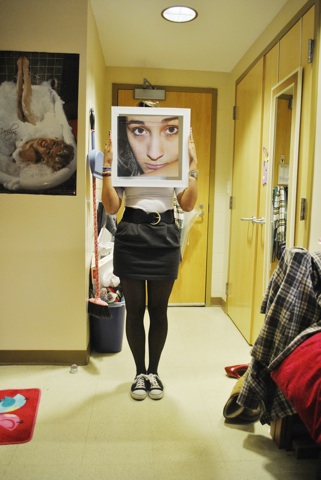
I started finalizing my persona assignment. I took a lot of different pictures of myself in back of the mirror. But this time I took them in a variety of places that mean something to me or are a part of my life. I also had my roommate (sophia) model for some of them . I took my pictures at the beach, in my room, at the dinning hall, around Portsmouth and outside at campus. I haven't photoshopped my face in the mirrors yet but I will be working on that.

Here are a few example..


week three: persona

I started taking pictures of my head behind a mirror. I thought this was a better way to show the shyness in my personality . I also really like the look of the pictures. 

This was the first picture I took that gave me the idea..


After taking these photos, I wanted to take the idea farther and add my face into the mirror. So I started playing around with photoshop copy&pasting...


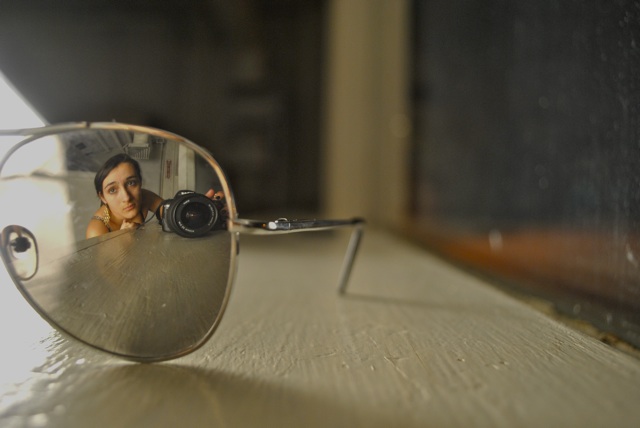
week two: persona

two weeks ago I started working with reflections. I thought reflecting myself in a mirror or other things would be a creative way to show my shy personality.  Here are the beginnings of that idea...


Sunday, February 13, 2011

Criticizing Photographs: Chapter 4

Chapter four goes into great detail about types of photographs.  The author explains 6 different types of photography. I was unaware that there was so many different types of photography. I guess I just have never thought about it. The categories are;  descriptive, explanatory, interpretive, ethically evaluative, aesthetically evaluative, and theoretical. Each type of photography is thoroughly explained and has the photographers work for an example. 
(Carrie Mae Weems, Mirror, Mirror, 1987)

      The image that most stood out to me was the reflection image called "mirror, mirror" by carrie Mae weems. I am trying to work with reflections for my persona assignment. I really like how this image is set up formally and I like the idea of looking through a mirror but someone else being on the other side. I would really like to experiment with this concept. I wanted to include my sisters in my persona assignment because they are a big part of who I am but I didn't know how to incorporate them. So I would like to follow similarly what this image is doing but have me look into the mirror and my sister on the other side of it by photoshopping it. 

Wednesday, February 9, 2011

persona: Week one photoshoot

I still am just playing around with lighting and body forms. I really like taking pictures of the body and I tried to show a little bit of my personality in these images...I have no idea what I want to do yet for this project but here is a start. I haven't photoshopped any of them yet.